Plurai Sets Out to Win the AI Race by Controlling How the “Vibes” are Positioned
Plurai positions itself as the trust layer for AI agents, focusing on testing, evaluating, and protecting them before real-world use. Their USP is “vibe-training,” a method for training AI agents to behave as desired, reducing failures and improving reliability.

The Setup
Most AI startups are still selling creation. Plurai is selling trust. The company positions itself as the layer that tests, evaluates, and protects AI agents before customers run into the ugly edge cases. Their hook is the phrase “vibe-training,” which packages a pretty technical process into something developers can repeat in conversation. Underneath it is a serious product: synthetic data generation, small language models trained for specific behaviors, fast evals, and production guardrails designed to reduce failures without slowing teams down.
Here is the Product Pitch | Plurai
What makes the branding move interesting is how clearly it captures where AI culture has shifted. A year ago the energy was around building agents at all. Now the anxiety is whether those agents can survive real-world use without hallucinating policies, breaking workflows, or drifting off-script. “Vibe-training” gives that fear a memorable label, which matters in a category crowded with terms like observability, evaluation, and compliance. The phrase feels casual enough to spread, while the product underneath speaks directly to enterprise reliability concerns. That balance is hard to pull off.
The Breakdown
Plurai
An Infotechnics™ analysis of how a product rates across eight areas of performance.
To explore in more detail, pinch out to zoom in
Plurai’s biggest advantage is not the model. It's “Vibe-training” as a positioning.
“Vibe-training” does what most AI infrastructure companies struggle to do. It turns an abstract reliability problem into language teams can immediately repeat, explain, and remember. The strongest scores land in messaging, differentiation, and marketing pitch because Plurai gives production AI anxiety a clearer shape than most of its competitors. The weaker area is design language, where the visual system still looks like a standard AI startup site carrying a sharper idea underneath it.
Brand Positioning and Identity
Plurai positions itself as the trust layer for production AI agents. The company is not selling another agent builder. It is selling the system that tests, evaluates, and protects agents before real users find the expensive mistakes. The phrase “vibe-training” is the smart land grab here. It gives Plurai a nameable method in a crowded AI reliability category, where everyone is talking about evals, guardrails, and observability. The brand identity is technical, but the wedge is memorable: teach your agent the behavior you want without turning every policy into a manual QA project.
Target Segment and Audience
The audience is AI product teams, developers, platform teams, and enterprise buyers trying to move agents from demo to production without getting embarrassed by edge cases. Plurai speaks to teams that already have agents in flight and know manual test sets, sampled reviews, and generic LLM judges are not enough at scale. Product Hunt comments point to the pain clearly: customer-facing agents can look fine until deeper evaluation reveals policy violations the team had not fully defined. That makes the buyer practical, not hype-driven. They want fewer surprises in production.
Messaging and Storytelling
The story is built around the gap between AI demos and AI reality. Plurai’s copy says agents and users are unpredictable, traditional testing does not work, and mistakes become expensive when they reach customers. “Vibe-training” gives that problem a simple product-language answer: describe the behavior, generate targeted synthetic data, train small evaluators, and run them as fast guardrails. It is technical enough for builders, but the phrase makes the category easier to repeat. That matters in AI, where half the battle is naming the pain before everyone else does.
Experience and Journey
The user journey moves from intent to working protection. Plurai presents the flow as prompt to SLM creation, with no labeled data required. The team defines the use case, Plurai generates targeted data, calibrates intent, and produces evals or guardrails that can run in production with latency under 100ms. That journey is aimed at removing the usual friction around testing agents: dataset building, policy translation, slow LLM-as-judge calls, and incomplete coverage. The buyer gets to feel like reliability is a workflow, not a research project.
Community and Culture Insight
Plurai is reaching the AI-builder crowd that has grown tired of beautiful demos failing in messy production environments. The culture has moved from “can we make an agent?” to “can we trust it with users, policies, tools, and business outcomes?” LangSmith, OpenAI, Anthropic, and Gartner all point to the same shift: evals and observability are becoming basic operating equipment for AI teams. Plurai enters that conversation with a stronger naming move than most. “Vibe-training” sounds casual, but it gives builders a handle for a real production concern.
Differentiation and Unique Selling Point
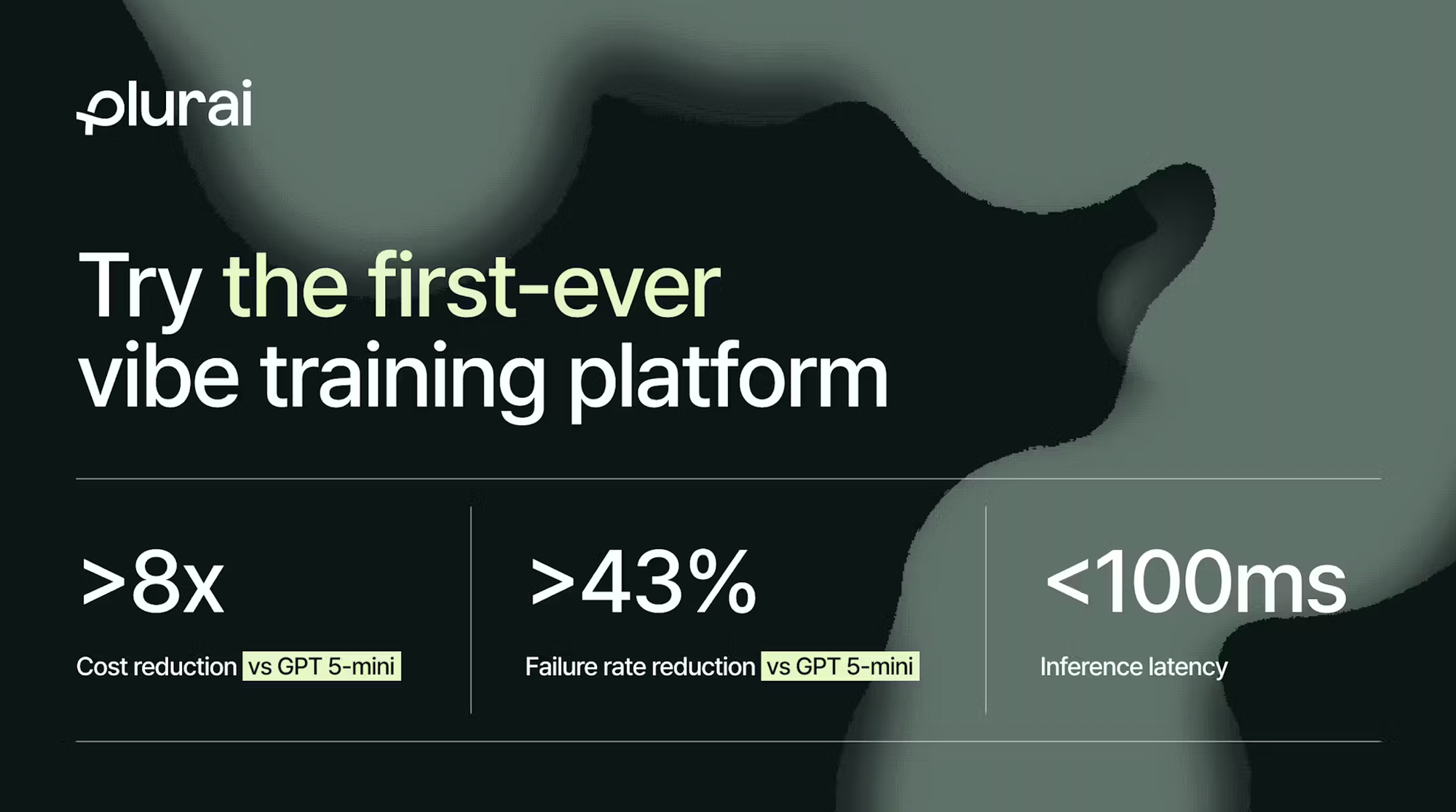
The USP is custom, real-time evals and guardrails trained around a team’s own use case. Plurai claims more than 43 percent failure-rate reduction versus GPT-5.2, more than 8x cost reduction, and under 100ms inference latency. The key difference is the small language model angle. Rather than relying only on expensive general-purpose LLM judges, Plurai trains focused models for specific semantic tasks like policy compliance, grounding validation, conversation evaluation, and similarity. That gives the brand a clean promise: more coverage, lower cost, faster protection.
Design Language
The design language is startup-clean with a reliability message doing the heavy lifting. The site leans on sharp product labels, simple metrics, dark interface imagery, and high-contrast proof points like 15x edge-case coverage, 7x shorter time to production, 100x reduction in policy violation and hallucination, under 100ms latency, and more than 8x lower cost. The visual system supports the sales story by making an abstract back-end product feel measurable. That is important because evals and guardrails can sound invisible until the numbers give buyers something to picture.
Marketing Pitch
The marketing pitch is: stop trusting vibes, start training them. Plurai takes a loose, culturally sticky phrase and turns it into a product method for AI teams that need reliable agents in production. The clever part is the naming. “Vibe-training” makes evals and guardrails feel less like compliance plumbing and more like a new development habit. Underneath the phrasing is a serious B2B offer: custom behavioral checks, lower latency, lower cost, and a path from agent demo to agent you can actually ship.
Is It A Winning Pitch?
Do you think “vibe-training” sticks as a category term, or does the industry eventually collapse back into plain old evals?
 Udi Mokady