
An Ongoing Experiment in Liminal Positioning
What if positioning isn’t a ladder but a map? An ongoing experiment in how brands move through perception, identity, and the changing geography of the consumer mind.

For the past nine months I’ve been running an experiment. I’ve called it Liminal Positioning. The idea behind it is simple: brands don’t stay still, either in how they behave or in how people relate to them in their minds.
In the book Positioning, Al Ries and Jack Trout talk about the brand ladder. Basically, every brand is ranked in the consumer’s head in a fashion similar to a BuzzFeed listicle from the 2010s.
My thinking on positioning has always treated traditional positioning as square one. Ries and Trout focus on positioning inside the head. In another article, I explored positioning outside the head, in the environment of the consumer, a concept I call Arena Building and Brand Footing. .
Back to inside the head, unlike Ries and Trout, I don't think positioning is a straight line. I don't think anyone's thinking is ever a clean straight line, including my own. I think our minds operate more spatially than that. How a consumer feels about a brand can shift slightly depending on their mood.
You may find that silly. But I can listen to a song and hate it one day. I know I'm just not in the mood for it. Then weeks later, when my mood or headspace has changed, I'll actually enjoy that same song. It has nothing to do with familiarity.
If that isn't a clean enough example, then ask yourself this: "What do you want to eat for dinner tonight?" Whatever you pick tonight, would you want to eat it every night and enjoy it in the same way? Probably not. You won't be in the mood for it.
The Liminal Positioning Map
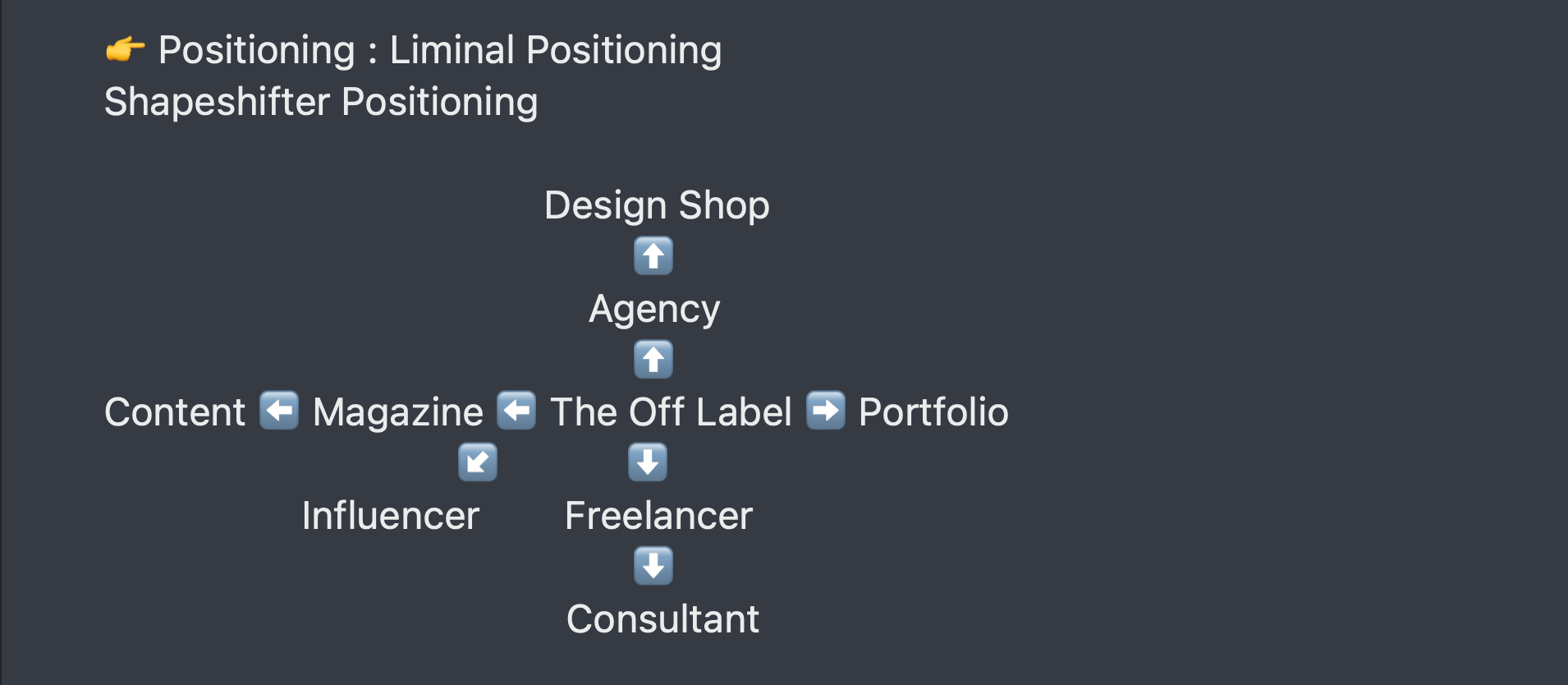
The image above is how I positioned The Off Label. My approach to the map was influenced by combining a few different ideas:
Blue Ocean Strategy

The influence of this is only conceptual. I didn't do the triangulation approach from the book to find a new market, like how Yellow Tail positioned itself for people who don't like wine, or how Cirque du Soleil replaced animals with theatrical performance.
What I did was almost the reverse. I plopped The Off Label in the middle and started filling in the things around it.
Reuven Feuerstein's Instrumental Enrichment (IE)
This is where Instrumental Enrichment comes into play. Although it was designed for "mediated learning," I've always found elements of it similar to Lateral Thinking. IE consists of a toolbox of exercises that help students develop strategies of intelligence.
One of the exercises focuses on Relational Intelligence. In an IE workbook, that might look like mapping how people in a family are related. In developing this positioning model, I started thinking about what The Off Label is in relation to other creative things, whether that be a company, platform, or something else.
A simple version of this is when ever you hear a book publicist pitch a book or writer as: She's Zadie Smith meets David Foster Wallace meet Dr. Seuss. That publicist is spatial positioning or triangulating their client somewhere in the mix of that.
A simple version of this is whenever you hear a book publicist pitch a book or writer as: "She's Zadie Smith meets David Foster Wallace meet Dr. Seuss."
That publicist is spatially positioning, or triangulating, their client somewhere in the mix.
Metaphysical Psychology of Shapeshifting

I touched a little on shapeshifting earlier using food and music as examples. Shapeshifting comes into play because no memory stays perfectly intact the further away we move from it in time. At first, your memory of an event is mostly accurate, filtered through your own subjectivity and experience.
Over time this changes. Why? Because each time you retrieve that memory, you are in a different headspace. The narrative you have of yourself today is much different than it was when the moment originally happened.
Your self-commentary annotates the memory. Your mood changes its shape until it becomes more of an interpretation of the moment that continues to evolve over time.
If brands are built around creating moments and experiences, they are not exempt from these same rules.
The Goals of Liminal Positioning

Going back to my positioning map, my goals were very simple and in no particular order:
- I wanted The Off Label to function as a portfolio for strategy in the same way a freelance designer has a portfolio for their creative work.
- I wanted the career optionality to freelance or consult if the opportunity presented itself.
- I wanted Ad Agency and Design Shop thinking, feel, and approach to become a cornerstone of the entire endeavor.
- I wanted people to encounter The Off Label first as a publication. That meant content that felt more magazine than content farm, and ideas that influence without becoming full modern-day influencer.
This positioning strategy is still in effect. Over the past nine months I have floated between the neighboring areas on the map, drawing influence from each to make The Off Label its own unique thing.
It's also still evolving. That means it's still an ongoing experiment.

