
Creative Collaboration Improves When More Voices Shape the Work
Diverse teams produce better creative work, but only when the process is designed for equity. Learn how to build brainstorming and leadership practices that actually include everyone.
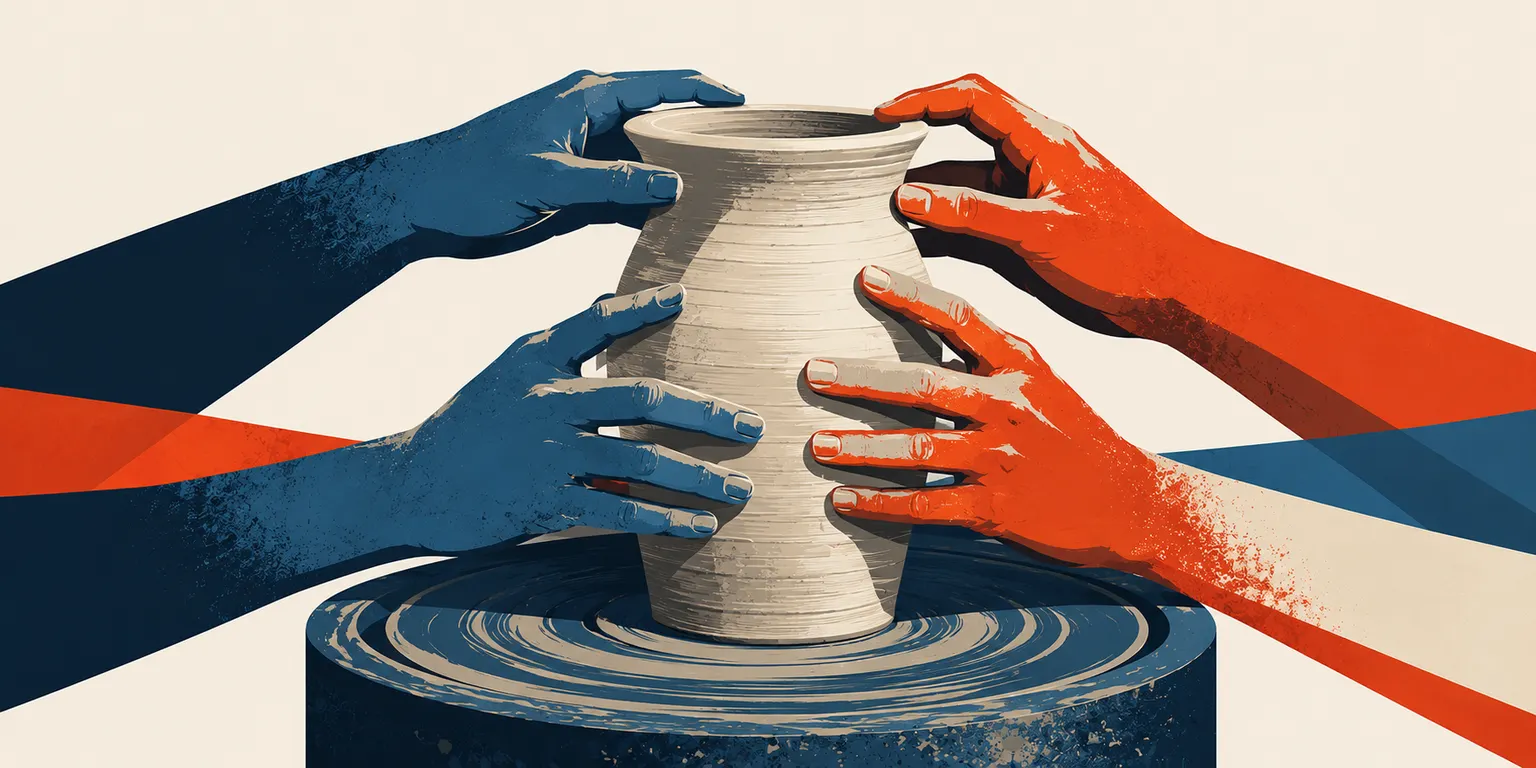
Most brainstorms are not actually brainstorms. They are performances where two or three people with the most confidence, the most tenure, or the most proximity to power talk while everyone else listens. The meeting ends. The loudest idea wins. And the organization calls it collaboration. This article takes that process apart, looks at what's actually going wrong, and explains what it takes to build creative environments where more voices genuinely shape the work.
Key Takeaways
- Diversity without inclusion produces decoration, not transformation. Having different people in the room changes nothing if the process still rewards the same voices.
- Equity in ideation requires structural intervention, not good intentions. Silent brainstorming, anonymous submissions, and round-robin formats are not soft practices; they are bias-reduction mechanisms.
- Empathetic leadership is a skill with learnable behaviors, not a personality trait reserved for certain kinds of leaders.
- Diverse teams make better decisions: according to Cloverpop (2017), decisions made and executed by diverse teams delivered 60% better results than those made by homogeneous groups.
- The gap between DEI as policy and DEI as practice is where most organizations stall, and it is the gap that matters most.
The Classic Idea: Collaboration Gets Better When More People Are Genuinely In It
Here is the version of this idea that gets cited at conferences: diverse teams are more creative. Varied backgrounds produce varied perspectives. Varied perspectives produce better ideas. The logic is clean, the research supports it broadly, and nobody argues against it publicly.
Boston Consulting Group surveyed employees at more than 1,700 companies across eight countries and found that companies with above-average diversity on their management teams reported innovation revenue that was 19 percentage points higher than those with below-average leadership diversity (BCG, 2018). That is not a marginal finding. It is a structural one.
The issue is not whether the idea is correct. It mostly is. The issue is that stating it correctly and enacting it correctly are two completely different operations, and the gap between them is where most organizations spend their entire DEI budget without producing any meaningful change.
So. What does it actually take?
Infotechnics · Participation design
Creative collaboration improves when more voices shape the work.
A diverse room does not produce diverse thinking when confidence, tenure, speed, or proximity to power still determines whose ideas receive airtime. Inclusion becomes real when the process changes who can influence the outcome.
The brainstorm equalizer
Change the format. Change who gets heard.
Switch between four ideation formats. The table shows how airtime is distributed; the idea stream shows how much of the room actually reaches the work.
Presence only matters when contribution reaches evaluation.
Share controlled by the two most dominant contributors.
The room is diverse. The decision process is not.
Equity is a performance variable
More perspectives improve the work only when the system can hear them.
Diversity changes who is present. Equity changes whether rank, confidence, language, processing style, or familiarity with power determines whose contribution becomes consequential.
Better results reported for decisions made and executed by diverse teams.
Faster decisions with fewer meetings in inclusive decision environments.
Innovation-revenue difference associated with above-average management diversity.
Believe their organization is more innovative when its culture is inclusive.
Inclusion is process design
Good intentions cannot restructure a biased format.
The strongest interventions are often simple formatting decisions that reduce the advantage held by fast, public, senior, or culturally dominant contributors.
Separate thinking from performance.
Everyone develops ideas independently before social dynamics begin shaping what feels acceptable.
Protects slower and reflective processingGuarantee the first contribution.
Each person speaks once before open discussion, preventing dominant voices from consuming the available airtime.
Distributes initial influenceEvaluate the idea before the identity.
Remove attribution during early evaluation so hierarchy and interpersonal assumptions have less leverage.
Reduces status and familiarity biasFund the contribution.
Time, tools, budget, and mentorship must follow ideas into execution.
Keep authorship visible.
Do not extract junior insight and transfer recognition upward.
Check the lived process.
Ask whether contributors felt heard and had what they needed.
Listen to be changed.
Empathy means allowing new information to alter the decision.
Diversity changes the room · equity changes the work
Start with the meeting. Look at who is talking, who is not, and what the format rewards.
More voices do not weaken creative direction. A well-designed process turns more of the room’s intelligence into work the room could not have produced otherwise.
What Everyone Gets Wrong About This
The most common misread is treating diversity as a destination. You hire a more representative team, you put the numbers in the annual report, and you consider the work done. This is the passive version of inclusion, and it fails reliably.
BCG found that even with a diverse management team in place, organizations that lacked the enabling conditions for inclusion -- fair employment practices, participative leadership, openness to new ideas -- saw significantly weaker results. Companies where those conditions were present reported nearly 13 percentage points more innovation revenue than those where the conditions were absent (BCG, 2018). The people were there. The ideas were not getting out.
The second misread is confusing diversity with equity. They are related but not the same thing. Diversity describes who is in the room. Equity describes whether the room is actually set up for them to participate. A brainstorming session where the agenda, the format, and the speaking order all advantage whoever is most extroverted, most senior, or most culturally similar to whoever designed the meeting is not an equitable process. It just has more bodies in it.
The third misread is treating inclusion as a values issue rather than a design issue. Organizations spend considerable resources on training people to have better values. That is not nothing. But values alone do not restructure a process that systematically advantages certain kinds of contributors over others. Process design does.
Consider the straightforward case of anonymous idea submission during ideation. When people cannot see who submitted an idea, they evaluate the idea on its merits rather than on their assumptions about the person who generated it. That is not a philosophical intervention. It is a formatting decision. And it changes outcomes.
What Actually Shifted, and Why It Matters Now
Something has changed in how organizations understand the relationship between representation and output. The workforce across industries is more diverse in every dimension -- race, gender, sexual orientation, age, spiritual identity, cultural background -- than at any point in recent organizational history. That is not a trend. It is a condition.
And the creative industries in particular have found themselves in an uncomfortable position. The products -- campaigns, content, design, strategy -- increasingly reach audiences with lived experiences that the teams producing them do not share. The mismatches show up publicly. Campaigns that miss the mark, products that fail to account for how different bodies use them, brand decisions that signal a profound absence of relevant perspective in the room. These are not isolated incidents. They are symptoms of a systemic gap.
What has shifted is the recognition that closing that gap requires changing the process of creative collaboration, not just the composition of the team. Inclusion is now understood to be operational. It shows up in how meetings are structured, how feedback is solicited, how decisions get made, and who has access to the resources needed to execute on ideas once they are approved.
Deloitte research found that 74% of people believe their organization is more innovative when it has a culture of inclusion (Deloitte, 2018). The same research found that cognitive diversity -- differences in thought, values, and personalities -- is linked to up to a 20% enhancement in team innovation. These are not abstract correlations. They describe what happens when the conditions for diverse contribution are built into how a team actually operates.
What This Looks Like Operationally
This is where most articles about creative collaboration and DEI become the most vague. "Create psychological safety." "Foster belonging." The advice is not wrong. It is just underspecified.
Here is what equitable creative collaboration actually requires at the level of practice.
How do you build equity into the ideation process itself?
The brainstorm, as traditionally run, is a high-variance format that rewards fast, confident, public thinkers. It disadvantages people who process more slowly, people for whom English is a second language, people who are newer to the group and uncertain of the social dynamics, and people from cultural backgrounds where dominating a group conversation is not the norm.
Structural alternatives include:
- Silent brainstorming: All participants write ideas independently before any sharing begins. This separates idea generation from social performance.
- Round-robin sharing: Each person contributes in sequence before open discussion begins. This prevents the loudest voice from consuming the available airtime.
- Anonymous idea submission: Ideas are submitted without attribution and evaluated before anyone knows who generated them. This reduces the influence of hierarchy and interpersonal bias on which ideas get taken seriously.
None of these techniques are radical. They are formatting choices. But they change who is able to contribute, and by extension, they change what the output looks like.
What does equity in execution actually mean?
Generating ideas equitably and then assigning their implementation inequitably is a reliable way to burn out the people whose contributions you just worked to include. Equity in execution means distributing resources -- time, budget, tools, mentorship, visibility -- in ways that allow all contributors to participate fully in the work.
This is harder than it sounds because organizations carry informal resource allocation habits that are rarely written down anywhere. A junior team member from an underrepresented group may generate the idea that shapes a campaign but find that the visible execution credit flows to someone more senior. That dynamic, repeated across projects, produces a particular kind of exit. Talented people leave because the environment extracts their contribution without reciprocating.
Feedback mechanisms matter here. Not the annual review, but the kind of ongoing check-in that surfaces whether people feel they have what they need, whether they feel heard in decisions, and whether the experience of working on the project matches the promises made at the outset.
What does empathetic leadership require practically?
Active listening is listed so often as a leadership competency that it has almost lost its meaning. What it describes is specific: a leader who asks questions with the genuine intention of changing their understanding, rather than confirming what they already think. That distinction is not subtle. It produces different conversations.
Emotional intelligence -- the ability to read and respond to the emotional states of team members -- is not an innate personality trait. It is a practiced skill, and organizations that treat it as learnable, and invest in developing it, create different environments than those that treat it as fixed. Empathy training workshops, diverse storytelling practices, recognition systems that reward collaborative and supportive behavior: these are not soft features of a workplace. They are the conditions under which diverse teams actually function well.
Here is a comparison of what low-inclusion and high-inclusion environments tend to produce across key creative collaboration dimensions:
Participation design · Organizational inclusion
Inclusion changes what teams can see—and how well they decide.
Broader participation affects more than representation. It changes the information available to the group, the speed of alignment, and the range of ideas the organization can use.
| Dimension | Low-Inclusion Environment | High-Inclusion Environment | Research Basis |
|---|---|---|---|
| Decision quality | Decisions reflect majority perspective | Decisions reflect broader input | Cloverpop (2017): 60% better outcomes from diverse teams |
| Decision speed | Slower, more revisiting required | Twice as fast with fewer meetings | Cloverpop (2017) |
| Innovation revenue | ~26% of revenue from new products | ~45% of revenue from new products | BCG (2018) |
| Employee trust | Lower, particularly among minority groups | Higher across the board | Great Place To Work Research |
| Idea generation | Dominated by senior/extroverted contributors | Broader, more varied input | Deloitte (2018) |
| Team innovation | Baseline | Up to 20% enhancement | Deloitte (2018) |
The pattern across the data is consistent. Equity in process is not a fairness concession. It is a performance variable.
What about the organizational infrastructure that supports all of this?
Individual leaders practicing empathy inside a system that has not changed structurally will eventually run out of runway. The process-level work requires organizational support: diversity audits that assess where gaps actually exist rather than where they are presumed to exist, inclusive recruitment that does not simply widen the funnel but changes what the funnel rewards, DEI metrics that track progress against specific goals rather than tracking activity, and allyship cultures that distribute the labor of inclusion beyond the people inclusion is meant to benefit.
Unconscious bias training is worth naming here with some precision. It raises awareness. It does not, on its own, change behavior consistently or sustainably. Organizations that treat bias training as the completion of their equity work rather than as one input into a larger system tend to find the results disappointing and then conclude that the system doesn't work. The training is not the system. Building a process that produces equitable outcomes even when individual bias persists -- that is the system.
The Work That Does Not End
There is a version of this conversation that treats inclusion as a project with a completion date. Get the numbers up, run the training, update the values statement, close the ticket. And there is a version that treats it as an ongoing condition of organizational life, something that requires as much attention as the creative work itself.
The second version is harder to sell internally and harder to sustain. It is also the one that produces the outcomes the data describes.
The workforce is not going to become less diverse. The audiences that creative work reaches are not going to become more homogeneous. The distance between who is making things and who those things are made for is a real gap, and it has real consequences. Closing it requires changing the process by which creative work gets made, from the first brainstorm through to the final decision about whose name appears on the final product.
That is not a peripheral concern. It is the work.
Start with the meeting. Look at who is talking. Look at who is not. Then ask why, and take the answer seriously.
Frequently Asked Questions
What is the difference between diversity, equity, and inclusion in creative collaboration?
Diversity refers to who is present on a team -- the range of backgrounds, identities, and experiences represented. Equity refers to whether the process is designed so that all team members can contribute fairly, regardless of rank, communication style, or cultural background. Inclusion describes whether the environment makes people feel genuinely valued and able to participate. All three can be present or absent independently of each other. A team can be demographically diverse but run every brainstorm in a format that systematically advantages one type of contributor. Addressing creative collaboration requires attending to all three.
What brainstorming techniques actually support equity of voice?
Silent brainstorming, round-robin sharing, and anonymous idea submission are the most evidence-supported techniques. Silent brainstorming separates idea generation from social dynamics by having participants write ideas before any group discussion. Round-robin sharing ensures each person contributes before open discussion begins, preventing dominant voices from consuming the session. Anonymous idea submission removes attribution from the evaluation stage, reducing the influence of hierarchy and interpersonal bias on which ideas get taken seriously. These are structural choices, not cultural ones, and they can be implemented without requiring significant organizational change.
How does empathetic leadership differ from being "nice" or conflict-averse?
Empathetic leadership involves actively understanding the perspectives and experiences of team members and using that understanding to make better decisions. It is not the same as avoiding difficult conversations or softening every critique. A leader can deliver honest, even critical feedback while still demonstrating that they understand how a team member experiences the situation. The practical behaviors associated with empathetic leadership include active listening, asking questions with genuine curiosity, and checking in regularly about whether people have what they need to do their work. Conflict avoidance often produces the opposite of inclusion: unresolved tension, unspoken concerns, and the quiet departure of people who concluded that their perspective was not welcome.
Why do DEI initiatives often fail to change creative team outcomes?
The most common failure mode is treating DEI as a values or hiring project rather than a process design project. Hiring more diverse teams without changing how creative collaboration is structured tends to produce the same outputs, because the process still rewards the same contributors. BCG research found that companies with diverse management teams but weak enabling conditions -- things like fair employment practices, participative leadership, and openness to new ideas -- saw significantly weaker innovation results than those where those conditions were present. The same report noted that 91% of companies have gender diversity programs in place, yet only 27% of women report having actually benefited from them. Having a program is not the same as having a functioning system.
How should organizations measure progress on equity in creative collaboration?
Measuring equity in creative collaboration requires more specificity than tracking representation numbers. Useful indicators include: the proportion of final ideas that originated from contributors outside the senior or dominant group; whether speaking time in ideation sessions is distributed across participants; whether team members from underrepresented groups report feeling heard in decision-making; and whether resource allocation during execution reflects the contributions made during ideation. Cloverpop research (2017) found that inclusive companies make better business decisions up to 87% of the time and that decisions from diverse teams delivered 60% better results. Those kinds of outcomes are measurable, and they give organizations a direct line between equity practices and performance metrics.
Is empathy training effective, and how should it be used?
Empathy training can be effective at raising awareness and developing specific skills, but its impact depends heavily on how it is implemented and what it is paired with. Training that stands alone as the primary DEI intervention tends to produce short-term awareness gains without sustained behavior change. Training that is part of a broader system – where leaders model empathetic behavior, where organizational practices reinforce inclusive habits, and where there is ongoing accountability – tends to produce more durable results. The most useful empathy training formats include exposure to diverse storytelling, practice in active listening, and exercises that surface how the same situation is experienced differently by different people. The goal is to change how leaders process information about their teams, not just to improve how they describe DEI in meetings.
An independent voice that will raise an eyebrow.
The Off Label is marketing strategy in action. We go further than what's on the surface. Every play, brief, strategy, and trend published here is proof of how we connect dots and turn ideas into an advantage.
Browse Full Foundations Archive →Published from the Charleston, South Carolina strategy lab. Synthesizing marketing behavior into actionable strategy for New York City and the world's creative hubs.
© 2026 The Off Label. All rights reserved. Content on this site may not be reproduced without prior permission.
NYC / LDN / CDMX / CHS

