
Global Strategic Intelligence: February 2026 (Part I)
Online content hits a "saturation" threshold as AI-authored output dominates the web. From geoeconomic fragmentation to the rise of "software-first" vision, the is world shifting from physical constraints to algorithmic ones.
The World This Week
This week feels less like acceleration and more like saturation.
The volume of content online has crossed into a strange threshold where the majority is now artificially produced, and the distinction between authored thought and generated output is becoming operationally irrelevant. For news organizations, this isn’t a philosophical debate. It’s a workflow crisis. Verification now includes determining whether the source was ever human, and distribution models are shifting as audiences migrate toward niche, influencer-led video ecosystems while legacy outlets continue to lose referral oxygen from traditional social platforms.
Trust isn’t collapsing in one dramatic implosion. It’s fragmenting. Quietly. Platform by platform.
Geopolitically, the World Economic Forum’s latest risk assessment from reads less like a forecast and more like a confirmation. State-based armed conflict and geoeconomic confrontation sit at the top of the list, not as abstract threats but as structural forces reshaping trade corridors, labor markets, and diplomatic alignments. Fraying transatlantic alliances and the sustained U.S.–China competition are no longer background conditions. They are active inputs into supply chain design and capital allocation, with emerging economies absorbing the volatility first and most intensely.
At the same time, the inflation narrative continues to split along income lines. While high-income economies are seeing food price increases stabilize, countries such as Iran (55.9%) and Argentina (33.2%) remain locked in severe cost-of-living pressure. This divergence is beginning to look less cyclical and more structural. The global recovery is tiered, and national resilience increasingly depends on a country’s ability to hedge against currency instability and commodity shocks rather than simply grow its way out of turbulence.
Business & Strategy
The AI conversation is maturing.
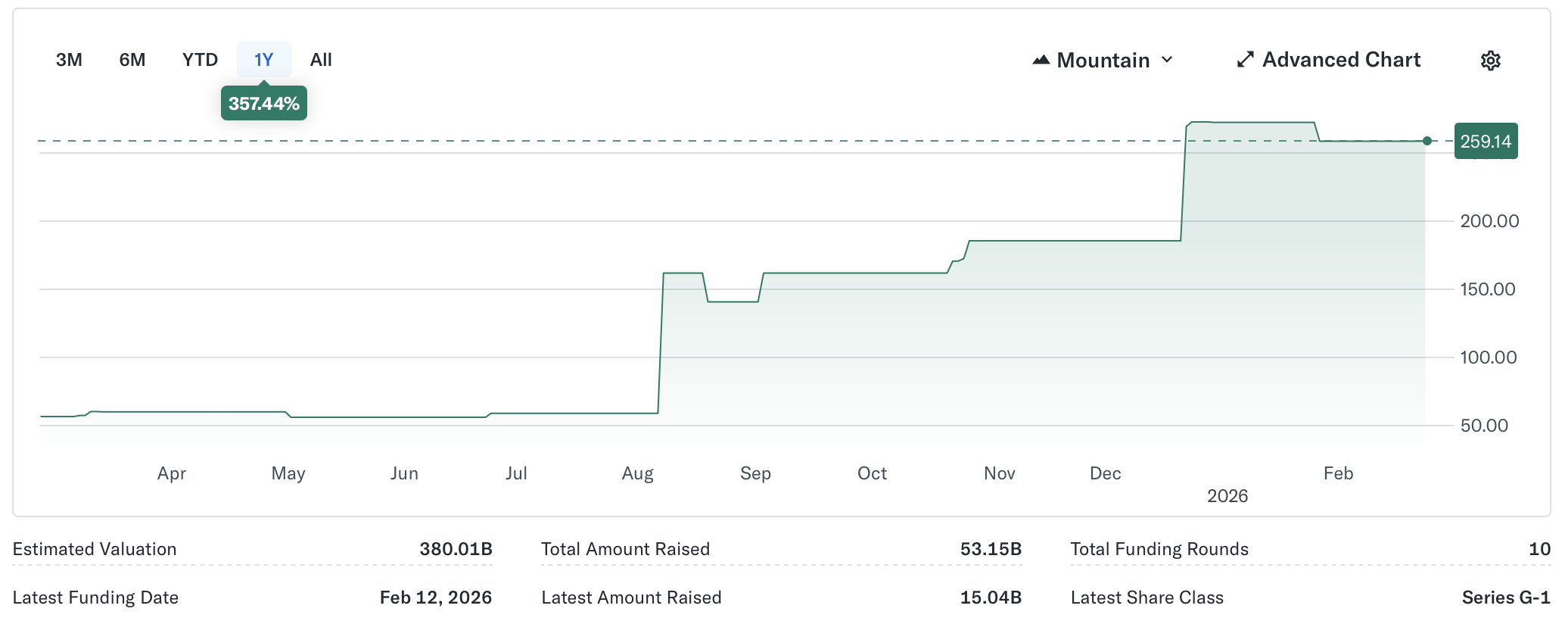
What was framed last year as existential disruption is now being recoded as integration. The market’s response to Anthropic’s latest enterprise deployments reflects this shift. Rather than positioning artificial intelligence as a wholesale replacement for legacy software, it is increasingly presented as a complementary layer that enhances existing SaaS infrastructure without detonating it.
That distinction matters.
Investor anxiety has eased in part because the narrative has shifted from overthrow to augmentation. The Dow has rallied modestly. Tech valuations have stabilized. The takeaway for 2026 is not that AI will remake corporate architecture overnight, but that it is being woven into it carefully, deliberately, and with an eye toward preserving operational continuity.
Corporations are no longer asking whether to use AI. They are asking how to embed it without collapsing the workflows that currently produce revenue. That is a much more pragmatic, and therefore more dangerous, phase of adoption.
Finance & Indicators
Sentiment is improving, but conviction remains thin.
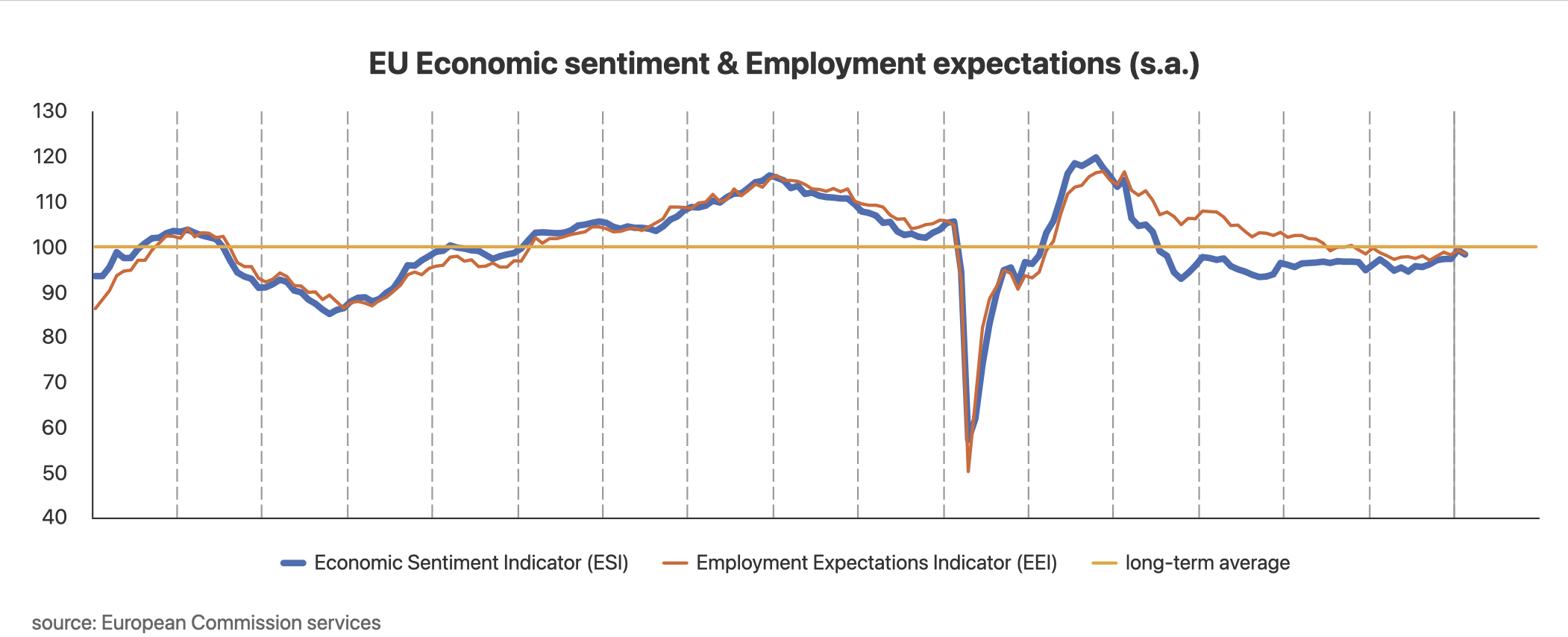
In the Eurozone, the Economic Sentiment Indicator (ESI) rose to 99.2, its closest approach to the long-term average since mid-2022. In the United States, consumer sentiment edged up to 57.3, with much of the optimism concentrated among households holding significant equity exposure.
The nuance is important. Asset appreciation is stabilizing confidence at the top of the distribution, while inflation fatigue continues to linger beneath it.
The University of Michigan’s preliminary year-ahead inflation expectations declined to 3.5% in February from 4.0% in January. That cooling suggests easing price anxiety, but not a full psychological reset. Markets feel better. They do not yet feel secure.
Science & Tech-Philosophy
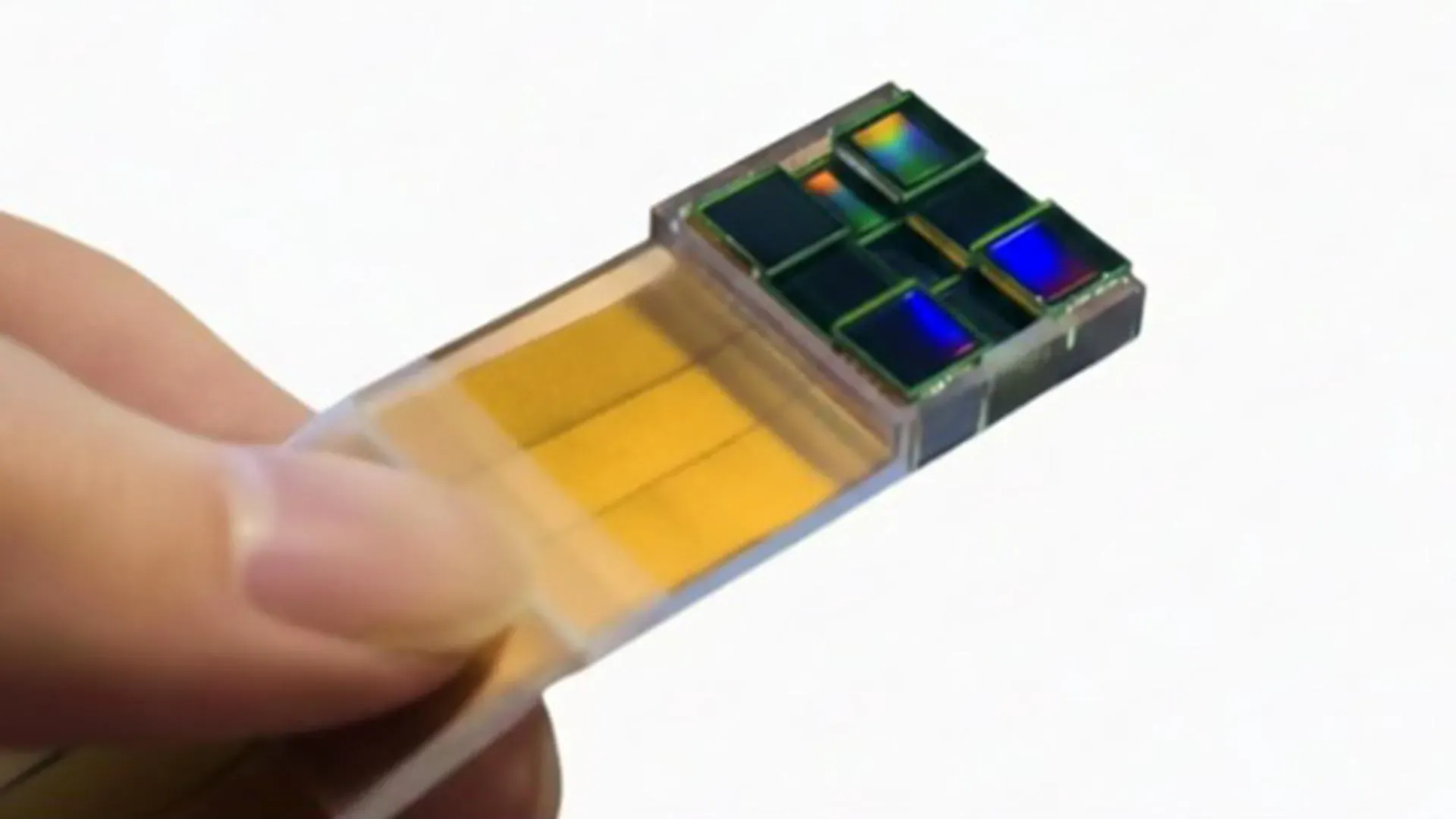
A breakthrough in Multiscale Aperture Synthesis Imaging (MASI) may end up being more culturally significant than it first appears.
Multiscale Aperture Synthesis Imaging (MASI) eliminates the need for traditional physical lenses by using coded sensors and computational synchronization to reconstruct images, effectively bypassing the classical diffraction limit. What was once a constraint of glass and curvature becomes a function of algorithmic reconstruction.
Technically, this is an optics story. Philosophically, it is something else.
For centuries, vision was defined by the quality of the lens. Precision manufacturing determined what could be seen. Now the fidelity of perception shifts toward code. The image is no longer constrained primarily by material form, but by computational interpretation.
We are inching toward a reality in which seeing becomes software-first. The eye still gathers light, but the system decides what that light means.
Visual Signal
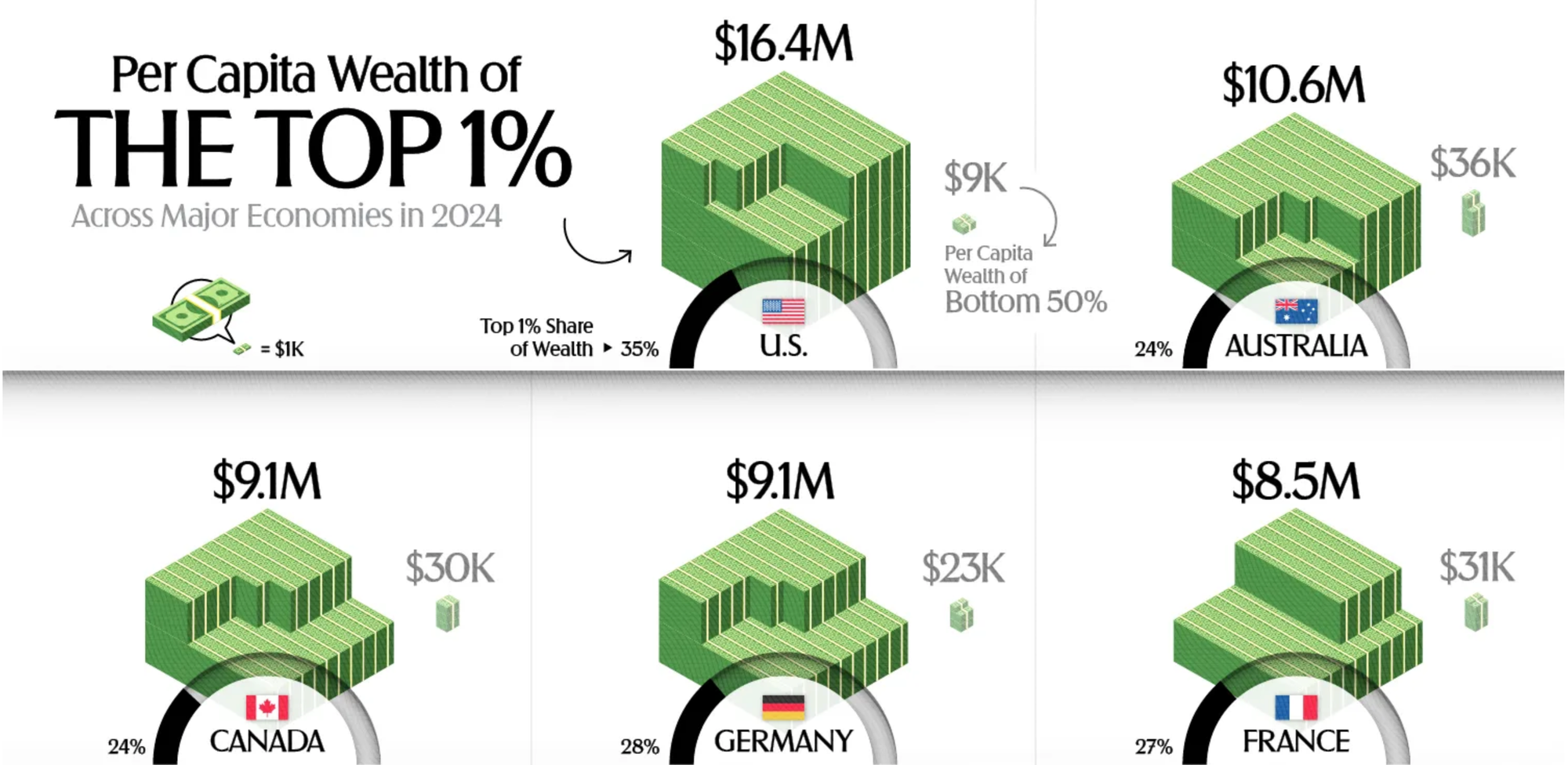
The week’s most clarifying image may be the Visual Capitalist’s Wealth Disparity Map.
In the United States, the average member of the top 1% holds $16.4 million in net worth. The bottom 50% hold approximately $9,000 per person. The scale of that gap reframes many downstream debates. Political polarization, social mobility, and economic anxiety are not merely ideological disputes. They are functions of purchasing power dispersion.
Wealth concentration translates into optionality. Optionality translates into insulation. And insulation alters behavior at both the ballot box and the boardroom.
Postscript
The passing of Philippe Gaulier, the legendary teacher of clowning who encouraged performers to find their “inner idiot,” feels symbolically well-timed.
In an era increasingly defined by automation and optimization, Gaulier’s philosophy stands as a quiet counterweight. The fool is inefficient, unpredictable, occasionally embarrassing. He does not scale cleanly. He resists algorithmic refinement.
And yet that unscripted humanity may be precisely what remains scarce.
As systems grow more precise, the value of imperfection increases. The chaotic, unoptimized gesture becomes a signal of life.

